| April
2009
- Vol. 29
Quotes
From
Early
Church
Fathers
on Christ's
Death
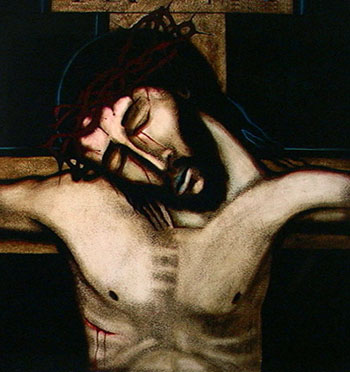
Crucifixion by Michael
O'Brien
.
What
Happened on the Cross?
by
John of Damascus
By
nothing else except the cross of our
Lord Jesus Christ has death been brought
low:
The
sin
of our first parent destroyed,
hell
plundered,
resurrection
bestowed,
the
power
given us to despise the things
of this world,
even
death
itself,
the
road
back to the former blessedness
made smooth,
the
gates
of paradise opened,
our
nature
seated at the right hand of
God,
and
we
made children and heirs of God. |
By the
cross all these things have been set
aright...
It
is a seal that the destroyer may
not strike us,
a
raising up of those who lie
fallen,
a
support for those who
stand,
a
staff for the infirm,
a
crook for the shepherded,
a
guide for the wandering,
a
perfecting of the
advanced,
salvation
for
soul and body,
a
deflector of all evils,
a
cause of all goods,
a
destruction of sin,
a
plant of resurrection,
and
a
tree of eternal life. |
[excerpted
from Orthodox Faith, 4]...
Go
to > Next
Page
> What
Happened on the Cross? by John
of Damascus
>
A
Few Drops of Blood Renew the Whole
World, by Gregory Nazianzen
>
The
Lamb
That Was Slain Has Delivered Us from
Death and Given Us Life,
by Melito of Sardis
>
The
Death
of Death, by Augustine of Hippo
.
|
Go
to > Next
Page
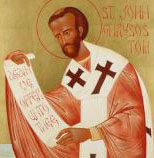
John
of Damascus
John
of Damascus, also known as John Damascene,
was born in 676. He was brought
up in Damascus Syria in a Christian family
living under Muslim rule. His
father was a government official under
both the Byzantine emperor and the
Muslim rulers of Damascus. John received a
classical education. His fields
of interest and contribution included law,
theology, philosophy, and music.
He was fluent in Arabic as well as Greek.
John worked in the Muslim court
until the hostility of the caliph toward
Christianity caused him to resign
his position, about the year 700.
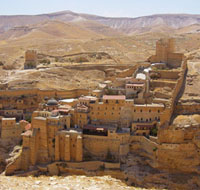
Mar
Saba Monastery, Judaean dessert
photo
by Shay Shtickgold
He
moved to the vicinity of Jerusalem and
became a monk at Mar Saba Monastery
located in the Judaean desert hills near
Bethlehem, 18 miles southeast
of Jerusalem. He taught in the monastery,
preached many sermons in Jerusalem,
and wrote both theological treatises and
hymns.
Since
he lived in the midst of political and
theological turmoil, John wrote
a great deal to clarify true doctrine and
to do his part in spreading the
gospel. He is recognized as one of the
principal composer of hymns in Eastern
Orthodoxy. His most important theological
work, The Fount of Wisdom,
is a summary of Eastern theology. He was a
key defender of the use of icons
during the iconoclast controversies.
John
is considered the last of the Greek church
fathers and the first of the
East to formulate a comprehensive
synthesis of Christian Dogma. John died
in 749. He worked to the very end and was
beloved by his fellow monks and
revered by the people. He was buried at
the Monastery of Mar Saba.
|
