February
2010
- Vol. 37
.
Witnesses
in the Jungle
Jim
Elliot, Nate Saint, & Fellow
Missionaries
by
Jeanne Kun
In January 1956 the world was shocked to hear
that a primitive tribe in the rain forest of
Ecuador had killed five American missionaries.
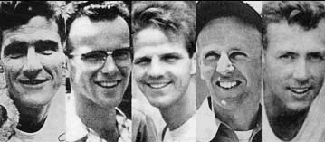
Jim Elliot, Nate Saint, Ed McCully, Pete
Fleming, and Roger Youderian had been working
at various jungle mission stations among the
Quichua and Jivaro Indians for several years.
The men, Protestant missionaries in their
twenties and thirties, had been accompanied by
their wives. Each couple was eager to share
the message of the gospel with those who had
never heard it. But, above all, they were
dedicated to the Lord himself and sought to be
obedient to him in all things.
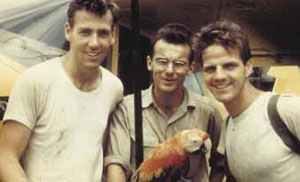
Ed
McCully, Pete Fleming, and Jim Elliot
Jim Elliot and his friends had hoped and
prayed to be able to make contact with an
isolated and hostile people known by other
tribes as the Aucas (“savages” in Quichua)
because of their fierce infighting and hatred
for outsiders. With his skill as a pilot for
the Missionary Aviation Fellowship, Nate Saint
had made it possible for the men to fly over
the Auca settlements deep into the jungle and
drop such gifts as cloth, axes, and cooking
pots to assure them that their intentions were
friendly and to win their trust. The Aucas
reciprocated, tying native gifts – a
parrot, a headband of woven feathers, manioc,
and bananas – onto the plane’s
drop-line.
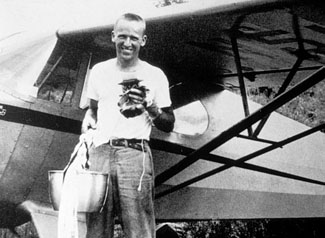
Nate
Saint next to his plane with camping
gear
When the mission team landed on the banks of
the Curaray River a few miles from the Auca
village and set up camp, their hopes were
rewarded: Three Aucas came out of the jungle
and spent the day at the camp trying to
communicate with the men, delightedly taking a
ride in the plane, and curiously inspecting
the missionaries’ equipment.
Two days later, on January 8, 1956, as Nate
flew over the camp, he saw a group of Aucas
headed toward it through the jungle. He landed
near the campsite on the river bank, shouted
the news “They’re on their way!” to Jim,
Roger, Pete, and Ed, and by radio notified
Marj Saint at the mission base of the
hoped-for meeting. The next designated radio
contact with their wives was never made.
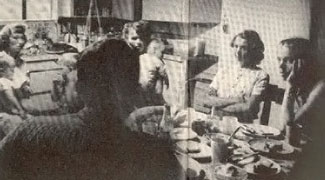
widows
listen to the report of their husbands
fate
The following morning, one of Nate’s
co-workers from the Missionary Aviation
Fellowship flew over the site in search of the
men and located the plane. All of its fabric
had been stripped. Later a body was sighted,
floating face down in the river, and then
another. An armed expedition made up of the
missionaries’ colleagues, military personnel,
and Quichuas set off on foot, hoping to find
the other men still alive somewhere in the
rain forest. A few days later, the other
bodies, speared and sprawled in the sand and
muddy river water, were discovered by
helicopter. The ground party recovered four of
the bodies and buried them on the banks of the
Curaray. The body of the fifth missionary had
been identified earlier by an advance party of
Quichuas, but was washed away in a
storm.
In the preface of Shadow of the Almighty:
The Life and Testament of Jim Elliot,
first published in 1958, Elisabeth Elliot
wrote:
| “Jim’s aim was to know God. His
course, obedience – the only
course that could lead to the
fulfillment of his aim. His end was
what some would call an extraordinary
death, although in facing death he had
quietly pointed out that many have
died because of obedience to God. He
and the other men with whom he died
were hailed as heroes, ‘martyrs.’ I do
no approve. Nor would they have
approved.
“Is the distinction between living
for Christ and dying for him, after
all, so great? Is not the second the
logical conclusion of the first?
Furthermore, to live for God is to
die, ‘daily,’ as the apostle Paul
put it. It is to lose everything
that we may gain Christ. It is in
thus laying down our lives that we
find them.
“Those who want to know him
[Christ] must walk the same path
with him. These are the ‘martyrs’ in
the scriptural sense of the word,
which means simply ‘witnesses.’ In
life, as well as in death, we are
called to be ‘witnesses’ – to
‘bear the stamp of Christ.’
“I believe that Jim Elliot was one
of these. His letters and journals
are the tangible ground for my
belief. They are not mine to
withhold. They are a part of the
human story, the story of a man in
his relations to the Almighty. They
are facts.”
|
Less than three years after the five men’s
deaths, Elisabeth Elliot and Rachel Saint,
Nate’s sister, made contact with the Aucas – who in
their own language called themselves Huaorani or
“the people” –
through the help of an Huaorani woman who
had earlier fled from her tribe. The Huaorani
accepted the two women and Elisabeth’s daughter
to live among them because they wondered why the
missionaries had let themselves be killed rather
than shoot any of their attackers. Then they
heard the full story of how the men had come to
tell them of Jesus, who “freely allowed his own
death to benefit all people.
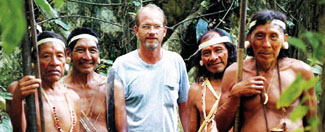
Steve
Saint continues to visit the tribe
regularly
Rachel spent more than thirty years working
among the Huaorani. Steve, Nate Saint’s son,
often visited his Aunt Rachel and grew up
knowing the men who learned to “walk on God’s
trail” after they had killed his father.
In an unbelievable expression of
reconciliation, Steve Saint, Nate’s son, was
baptized by two of the men who murdered his
father, in the very river where his father
died. Steve Saint has worked as a missionary
in West Africa, Central America and South
America.
At the request of the Waodani elders, he
returned to the Amazon in 1995 along with his
wife and children to live among the tribe for
several months. While working with the
Huaorani to build an airstrip in the jungle,
Steve Saint spoke with Gikita, the leader of
the attack. Then eighty years old, Gikita was
eager to “go to heaven and live peacefully
with the five men who came to tell him about
Wangongi, creator God.”
Jeanne
Kun is a noted author and a senior womens'
leader in the Word
of
Life Community, Ann Arbor, Michigan,
USA.
This
article is excerpted from the book, Even Unto
Death: Wisdom from Modern Martyrs,
edited by Jeanne Kun, The Word Among
Us Press, © 2002. All rights reserved.
Used with permission. The book can be
ordered from WAU
Press.
Recommended
reading:
Shadow
of
the Almighty: The Life and Testament of
Jim Elliot, by Elisabeth Elliot, 1958
End
of the Spear, by Steve Saint, Tyndale
House Publishers (15 May 2006)
Recommended
viewing:
Testimony by Steve
Saint, End of the Spear,
YouTube video
Beyond
the
Gates of Splendor, story of Jim
Elliot and missionary companions, YouTube
video
|
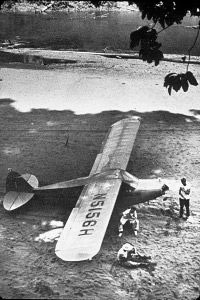
team on
the banks of the Curaray River
From Jim
Elliot’s journal:
He is no
fool who gives what he cannot keep to
gain what he cannot lose. (1949)
God, I
pray Thee, light these sticks of my life
and may I burn for Thee. Consume my
life, my God, for it is Thine. I seek
not a long life, but a full one, like
you, Lord Jesus. (1948)
Father,
take my life, yea, my blood if Thou
wilt, and consume it with Thine
enveloping fire. I would not save it,
for it is not mine to save. Have it
Lord, have it all. Pour out my life as
an oblation for the world. Blood is only
of value as it flows before Thine altar.
(1948)
Gave
myself for Auca work more definitely
than ever, asking for spiritual valor,
plain and miraculous guidance. . . .”
(May 1952)
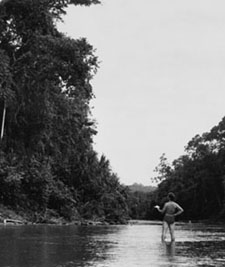
Jim Elliot
in the Curaray River surveys the jungle
A hymn
written by Jim Elliot in Quichua,
describing what happens when a man
dies, using a simile from Ecclesiastes
11:3 which was simple and
understandable to the Indians:
“If a man
dies, he falls like a tree.
Wherever
he falls, there he lies.
If he is
not a believer, he goes to the
fire-lake.
“But on
the other hand, a believer,
If death
overtakes him,
Will not
fall, rather will rise
That very
moment, to God’s house.”
Nate
Saint’s description of his work serving
pioneering missionaries through
aviation:
Their call
of God is to the region beyond the ends
of civilization’s roads—where there is
no other form of transportation. They
have probed the frontiers to the limit
of physical capacity and prayed for a
means of reaching regions beyond—a land
of witch doctors and evil spirits—a land
where the woman has no soul; she’s just
a beast of burden—a land where there’s
no word for love in their vocabulary—no
word to express the love of a father for
his son. In order to reach these people
for whom Christ died, pioneer
missionaries slug it out on the jungle
trails day after day, sometimes for
weeks, often in mud up to their knees,
while up above them the towering
tropical trees push upward in a
never-ending struggle for light.
It is our
task to lift these missionaries up off
those rigorous, life-consuming, and
morale-breaking jungle trails—lift them
up to where five minutes in a plane
equals twenty-four hours on foot. The
reason for all this is not a matter of
bringing comfort to the missionaries.
They don’t go to the steaming, tropical
jungles looking for comfort in the first
place. It’s a matter of gaining precious
time, of redeeming days and weeks,
months and even years that can be spent
in giving the Word of Life to primitive
people.
May the
time never come when mankind no longer
hears the soft footsteps of the herald
angel, or his cheering words that
penetrate the soul. Should such a time
come all will be lost. Then indeed we
shall be living in bankruptcy and hope
will die in our hearts.
Nate
Saint’s description of the first gift
drop made to the Aucas:
We
continued circling until the gift was
drifting in a small lazy circle below
us, ribbons fluttering nicely. Finally
the gift appeared to be pretty close to
the trees below. Once I believe the
ribbons dragged across a tree and hung
up momentarily. We held our breath while
the kettle lowered toward the earth. It
hit about two or three feet from the
water directly in line with the path to
the house. Finally the line was free and
there was our messenger of good will,
love and faith two thousand feet below
on the sandbar. In a sense we had
delivered the first gospel message by
sign language to a people who are a
quarter of a mile away vertically . . .
fifty miles away horizontally . . . and
continents and wide seas away
psychologically.
From Jim
Elliot’s last letter to his parents,
written on December 28, 1955:
By the
time this reaches you, Ed [McCully] and
Pete [Fleming] and I and another fellow
[Roger Youderian] will have attempted
with Nate a contact with the Aucas. We
have prayed for this and prepared for
several months, keeping the whole thing
secret (not even our nearby missionary
friends know of it yet). Some time ago
on survey flights Nate located two
groups of their houses, and ever since
that time we have made weekly friendship
flights, dropping gifts and shouting
phrases from a loud speaker in their
language, which we got from a woman in
Ila. Nate has used his drop-cord system
to land things right at their doorstep
and we have received several gifts back
from them, pets and food and things they
make tied onto this cord. Our plan is to
go downriver and land on a beach we have
surveyed not far from their place, build
a tree house which I have prefabricated
with our power-saw here, then invite
them over by calling to them from the
plane. The contact is planned for Friday
or Saturday, January 6 or 7. We may have
to wait longer. I don’t have to remind
you that these are completely naked
savages (I saw the first sign of clothes
last week—a G-string), who have never
had any contact with white men other
than killing. They do not have fire
except what they make from rubbing
sticks together on moss. They use bark
cloth for carrying their babies, sleep
in hammocks, steal machetes and axes
when they kill our Indians. They have no
word for God in their language, only for
devils and spirits. I know you will
pray. Our orders are “the gospel to
every creature.”
—Your
loving
son and brother, Jim
From a
letter written by Elisabeth Elliot to
her parents on January 11, 1956, while
the five wives were waiting for news of
the fate of their husbands:
I want you
to know that your prayers are being
answered moment by moment as regards
me—I am ever so conscious of the
everlasting arms. As yet we know only
that two bodies have been sighted from
the air but not identified.
Jim was
confident, as was I, of God’s leading.
There are no regrets.
Nothing
was more burning in his heart than that
Christ should be named among the Aucas.
By life or death, oh, may God get glory
to himself.
Pray that
whatever the outcome I may learn the
lessons needful. I want to serve the
Lord in the future, so pray for his
continued grace and guidance. I have no
idea what I will do if Jim is dead, but
the Lord knows and I am at rest.
We hope
for final word tomorrow and trust our
loving Father who never wastes anything.
All my love,
Betty
Selection of
quotes from
Shadow of
the Almighty: The Life and Testament of
Jim Elliot, by Elizabeth Elliot.
Copyright 1985 by Elizabeth Elliot
(HarperCollins Publishers Inc.)
Jungle
Pilot: The Life and Witness of Nate
Saint, by Russel T. Hitt.
Copyright 1959 by The Fields, Inc.
(HarperCollins Publishers Inc)
|
