 June
2007
- Vol. 9 June
2007
- Vol. 9
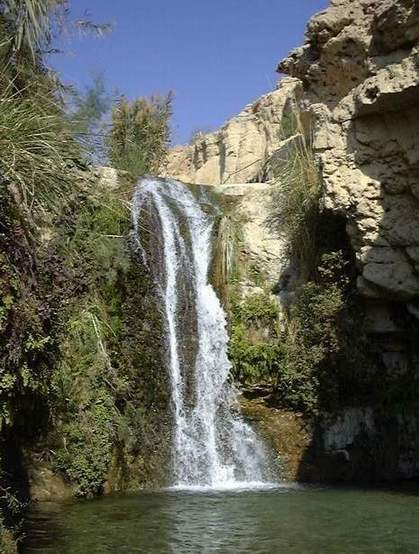
Pool of Nahal David at Ein Gedi,
Israel - photo by Don Schwager
First Fruits
of Pentecost - Shavuot:
linking the
Jewish Feasts of Passover and Pentecost and
seeing their fulfilment in the Christian
feasts
compiled by
Don Schwager
Celebrating God's wonderful
deeds
The Feast of
Pentecost, called Shavuot in Hebrew, is one of
the three major Jewish pilgrim festivals in the Old
Testament, along with Passover and Sukkot. In Jesus'
time, pilgrims from around the known world traveled to
Jerusalem to celebrate this great feast. Pentecost,
which literally means "fifty days", refers to the
number of days from the offering of the barley sheaf
at the beginning of Passover. It is also called the
"feast of Weeks", since the time elapsed from Passover
was 7 weeks plus 1 day; the "Day of the Firts Fruits",
when the first fruits of the spring harvest were
offered in the temple; and the "Festival of the Giving
of the Torah" (Hag Matan Torateinu). The
celebration is described in the the Books of Exodus
23:14-17 and 28:26-31, Numbers 28:26-31, and
Deuteronomy 16:9-12.
The Jewish Passover
celebrated Israel's physical freedom from bondage in
Egypt, and the giving of the Torah (the Ten
Commandments) on Shavuot celebrates the spiritual
freedom from bondage to idolatry and immorality.
Shavuot is the anniversary of the giving of the law at
Mount Sinai, where God made a covenant with his people
and gave them a new way of life embodied in the 10
commandments. The Sadducees celebrated it on the 50th
day from the first Sunday after Passover.
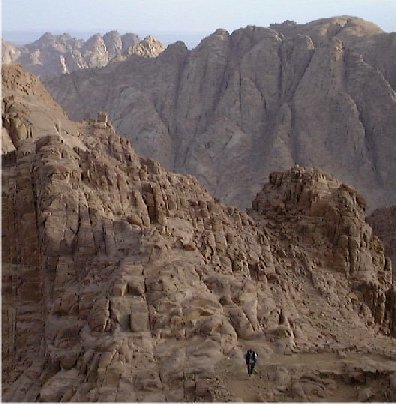
Mount Sinai, Egypt -
photo by Don Schwager
The following Jewish
prayer for this feast was comprised by an unknown
author from the Middle Ages:
For
the Feast of Weeks
I will
always remember the wonderful deeds of the Lord
when Israel was in
Sinai,
when Moses led the
people out of Egypt into freedom.
They stood purified
at the foot of the mountain
to receive your law,
your holy law; which they swore to obey for ever.
and Israel was a holy
nation in the midst of all the nations,
a holy thing and
precious to the Lord.
High on the
mountain your voice, Lord, was heard,
revealing great
things:
and then the blind
saw your light and the deaf heard your voice,
while the dumb
opened their mouths to speak to you.
And then, O Lord,
you revealed yourself
to those who had
sought you and you said to them:
I am the rock, I am
your shield and your defence, I am the only God.
You appeared in
majesty, glory, and splendor,
to deliver your
commandments.
And young and old
alike were surrounded by the same glory
that surrounds you
and your greatness.
And still today in
my heart and soul and in my every thought
I bless the marvels
and wonders that you, O Lord, perform.
When the days of Pentecost were
fulfilled!
The Jewish Feasts of
Passover and Pentecost are fulfilled in the death,
resurrection, and ascension of the Lord Jesus and the
sending of the Holy Spirit upon the disciples of
Jesus.
Basil the Great, one
of the early church fathers from the 4th century,
describes how these feasts were fulfilled in the New
Covenant established by Christ:
Pentecost
is the culmination of the work of our salvation, that
mighty plan of God's mercy which originated long ago
when the Lord first began to form a people for
himself. How many mysterious signs can be discovered
in this feast which link the old dispensation with the
new, teaching us that the law of Moses was the herald
of the grace of Christ, in which it was to find its
fulfillment!
Fifty days after
the sacrifice of the lamb marking the deliverance of
the Hebrews from the Egyptians, the law was given to
the people of Israel on Sinai; and fifty days from
the resurrection of Christ after his immolation as
the true Lamb of God, the Holy Spirit came down upon
the new Israel, the people who put their faith in
Jesus. The same Holy Spirit was the author of both
Old and New Testaments; the foundations of the
gospel were laid with the establishment of the old
covenant. What a wealth of meaning can be found,
therefore, in the opening words of the second
chapter of Acts, "When the days of Pentecost were
fulfilled"!
|
. |
|