|
The
Spirit Restores Paradise to Us
.by
Basil the Great
“The Spirit restores paradise to us and the
way to heaven and adoption
as children of God; he instills confidence
that we may call God truly Father
and grants us the grace of Christ to be
children of the light and to enjoy
eternal glory. In a word, he bestows the
fullness of blessings in this
world and the next; for we may contemplate now
in the mirror of faith the
promised things we shall someday enjoy.
If this is the foretaste, what must the
reality be? If these are the
first fruits, what must be the harvest?”
|
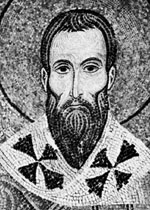 Basil
of Caesarea, also known as Basil the Great, was
born in Cappadocia (now
present day Turkey) in 330 AD. He studied at
Constantinople and then at
Athens (351-356) where two of his classmates
were Gregory of Nazianzus
(who became a close friend) and the future
Emperor Julian the Apostate.
Basil wanted to be an lawyer and orator, but his
sister Macrina persuaded
him to seek the monastic life instead. After
making a tour of the monasteries
of Egypt in 357, he founded a monastic
settlement near his home where he
lived for five years. Basil established
guidelines for monastic life which
focus on community life, liturgical prayer, and
manual labor. Basil expressed
a preference for the communal life of the
monastery over the solitary life
of the hermit, arguing that the Christian life
of mutual love and service
is communal by its nature. His Rules became the
standard for monastic life
in the East.Together with Pachomius he is
remembered as a father of communal
monasticism in Eastern Christianity. Basil
of Caesarea, also known as Basil the Great, was
born in Cappadocia (now
present day Turkey) in 330 AD. He studied at
Constantinople and then at
Athens (351-356) where two of his classmates
were Gregory of Nazianzus
(who became a close friend) and the future
Emperor Julian the Apostate.
Basil wanted to be an lawyer and orator, but his
sister Macrina persuaded
him to seek the monastic life instead. After
making a tour of the monasteries
of Egypt in 357, he founded a monastic
settlement near his home where he
lived for five years. Basil established
guidelines for monastic life which
focus on community life, liturgical prayer, and
manual labor. Basil expressed
a preference for the communal life of the
monastery over the solitary life
of the hermit, arguing that the Christian life
of mutual love and service
is communal by its nature. His Rules became the
standard for monastic life
in the East.Together with Pachomius he is
remembered as a father of communal
monasticism in Eastern Christianity.
Basil returned to public life at the call of
his bishop, Eusebius of
Caesarea, to join in the battle against
Arianism. He was ordained priest
and then succeeded Eusebius as bishop in 370
AD. In addition to his work
as a theologian and defender of the faith,
Basil was known for his care
of the poor and underprivileged. In 367-8,
when Cappadocia suffered a severe
and widespread famine, Basil sold his family's
extensive land holdings
in order to buy food for the starving,
persuading many others to follow
his example, and putting on an apron to work
in the soup kitchen himself.
In this crisis, he refused to allow any
distinction to be made between
Jew and Christian, saying that the digestive
systems of the two are indistinguishable.
He also built a hospital for the care of the
sick, housing for the poor,
and a hospice for travelers.
|
